Monday, September 3, 2018

Supreme Court to Rule Whether Pirate Streaming Damages Are Fair

Running alongside the incredibly popular torrent site The Pirate Bay, Dreamfilm was a Swedish portal that offered content in the increasingly popular streaming format.

With no fancy software needed, the site enjoyed considerable growth, particularly among locals seeking quick and easy access to the latest local and Hollywood movies.

In January 2015 and after capturing millions of visitors, Dreamfilm announced it would close down after one of its administrators was detained by the authorities.

A month later, apparently in response to the upheaval at Dreamfilm, several other sites fell including the country’s second largest torrent site Tankefetast, torrent site PirateHub, and streaming portal Tankefetast Play (TFPlay). Anti-piracy group Rights Alliance described the four linked sites as Europe’s leading players in file-sharing and streaming.

Four men, aged in their 20s and 30s, were eventually hauled to court, with each admitting involvement but confessing no crimes.

The Linköping District Court found them all guilty of copyright infringement offenses and sentenced them to between six to 10 months in jail. They were also ordered to pay a fine of SEK 1,000,0000 (US$109,500) to plaintiffs including the Swedish Film Industry, Nordisk Film, and Walt Disney.

With all parties dissatisfied with the outcome – sentences too harsh for the defendants and not aggressive enough for the plaintiffs – the case went to appeal. Citing recent clarifications of EU law, the defendants argued that the content offered on the sites was already online and could be accessed in other ways. This, they said, meant the content had not been “made available to a new audience”.

The Court of Appeal, however, sided with the District Court, agreeing that the links on the site targeted a new and unauthorized audience and therefore amounted to copyright infringement. The samples detailed in the case meant that the men committed between 45 and 188 infringements each and were motivated by profit, as determined by the advertising present on the platforms.

Where the Court of Appeal differed in its opinion was on the punishments that should be handed down. The financial penalty was more than quadrupled from SEK 1,000,000 to SEK 4,250,000 (US$465,500) but the immediate jail sentences pressed for and then obtained by the plaintiffs were removed.

Due to the fact that the men were all relatively young, had never been in trouble with the authorities, and were unlikely to offend again, the Court of Appeal wiped out their custodial sentences, replacing them with conditional ones instead.

While this was welcomed by the defendants, the hugely increased damages bill was hard to swallow, despite the movie companies in question originally demanding more than SEK 9,000,000 (US$985,800). The four million damages award, the Court of Appeal ruled, was the amount a hypothetical license to distribute would have cost.

DagensJuridik reports that two out of the four men have now taken their case to the highest court in the land, the Högsta Domstolen (Supreme Court).

Unlike the lower court, the Supreme Court will not determine the guilt or otherwise of the defendants. The hearing will only concern whether the damages award and compensation for the film industry was reasonable when it was set at SEK 4,250,000 (US$465,500).

The Supreme Court will also have no involvement in the conditional sentences previously handed down by the Göta Hovrätt (Court of Appeal). They will stand as previously ordered, with two of the defendants paying daily fines, penalties based on the offender’s daily personal income.

Also under consideration by the Supreme Court is the ruling handed down in the Swefilmer case. In March this year, two men had their sentences increased by the Court of Appeal in Sweden.

After originally being told to serve three years in prison, the main operator of the site had his sentence increased to four years with additional damages on top. The second man’s conditional sentence was augmented with a fine.

Swedish anti-piracy outfit Rights Alliance has long campaigned for harsher sentences for copyright infringement offenses in Sweden, particularly those handed down in connection with file-sharing platforms. It argues that when courts go soft on offenders, it only encourages others to set up similar operations in what is then perceived as a safe(r) haven.

Source: TF, for the latest info on copyright, file-sharing, torrent sites and more. We also have VPN reviews, discounts, offers and coupons.


from TorrentFreak https://ift.tt/2NbkypL
via IFTTT

Top 10 Most Pirated Movies of The Week on BitTorrent – 09/03/18

This week we have two newcomers in our chart.

Ocean’s Eight is the most downloaded movie.

The data for our weekly download chart is estimated by TorrentFreak, and is for informational and educational reference only. All the movies in the list are Web-DL/Webrip/HDRip/BDrip/DVDrip unless stated otherwise.

RSS feed for the articles of the recent weekly movie download charts.

This week’s most downloaded movies are:
Movie Rank Rank last week Movie name IMDb Rating / Trailer
Most downloaded movies via torrents
1 (2) Ocean’s Eight 6.3 / trailer
2 (1) Deadpool 2 8.0 / trailer
3 (5) Hereditary 8.7 / trailer
4 (3) Avengers: Infinity War 8.7 / trailer
5 (…) Reprisal 4.4 / trailer
6 (4) Upgrade 7.7 / trailer
7 (8) Jurassic World: Fallen Kingdom (subbed HDRip) 6.5 / trailer
8 (…) Superfly 4.9 / trailer
9 (10) Rampage 6.3 / trailer
10 (9) Skyscraper (subbed HDRip) 6.1 / trailer

Source: TF, for the latest info on copyright, file-sharing, torrent sites and more. We also have VPN reviews, discounts, offers and coupons.


from TorrentFreak https://ift.tt/2MFZ59b
via IFTTT

Sunday, September 2, 2018

Hollywood Studios Flag Their IMDb Listings as “Pirate” Links

Every single day, largely automated bots scour the web for references to pirated content.

These links are then reported to various online services, such as Google, requesting the operators to remove the allegedly infringing content.

This works fine, most of the time. But, in common with their human counterparts, these bots aren’t perfect. This was made painfully visible last month when Topple Track had to disable its reporting tool after it triggered a wave of faulty takedown notices.

That was not an isolated incident though. None of these takedown tools are perfect.

Over the past few weeks, we noticed another worrying trend. Suddenly, Google started to receive a lot of DMCA notices for the Internet Movie Database, with the majority of these requests coming from the UK-based reporting agency Entura International.

Since it’s unlikely that the movie site, which has been operating legally for 27 years, had suddenly gone rogue, something else must be up.

We decided to take a closer look at the reports in question, which were sent on behalf of well-known companies including Columbia Pictures, National Geographic, and Sony Pictures Television. Most of the links in these notices indeed reference classic pirate sites.

Good notice

The IMDB links are mostly used as a reference to the original content. However, it appears that due to a bug in the system the IMDb links move to the “infringing content” field when there are no pirate links to report, as shown below.

Bad notice

This is a rather obvious bug. However, after several weeks it has yet to be corrected. As a result, Google has been asked dozens of times to remove legitimate IMDb URLs from its search results.

TorrentFreak reached out to Entura to report this issue, and request a comment, but at the time of writing, we have yet to hear back.

Google, meanwhile, has widely put IMDb on its whitelist. This means that none of the inaccurately reported links have been removed. However, a smaller or relatively unknown site may not be that lucky, when it comes to these type of mistakes.

Source: TF, for the latest info on copyright, file-sharing, torrent sites and more. We also have VPN reviews, discounts, offers and coupons.


from TorrentFreak https://ift.tt/2CiuKZk
via IFTTT

CreativeFuture Launches Withering Attack on Google Over Copyright

Before getting hired by Google back in 2010, lawyer Fred von Lohmann was a senior attorney at the EFF dealing with intellectual property matters.

In March 2018, after serving as Google’s legal director for copyright issues, von Lohmann left the company, having fought many battles in favor of Google’s right to use third-party content on its services.

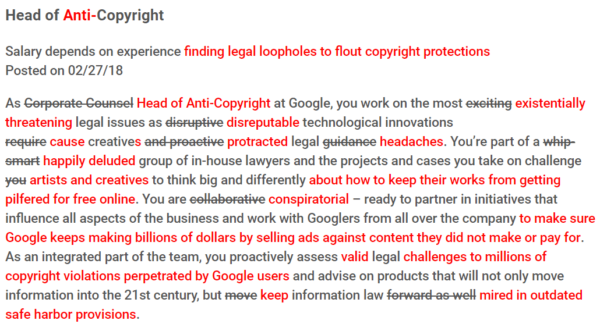
This led to Google advertising for a new Head of Copyright, highlighting all the great qualities a candidate must possess to qualify for such a lofty position. While it’s unclear if the role has been filled, the posting has since been removed – but not before pro-copyright group CreativeFuture got its hands on it.

The coalition, which claims to represent more than 520 companies and organizations and over 160,000 creative individuals, published a “corrected” version this week, in which it highlights the qualities it believes a person will need to get the job. It pulls no punches.

“Following a thorough analysis by our in-house team of creativity defenders, we at CreativeFuture have determined that certain key details of the posting may be in need of revision – so as to present a more accurate portrayal of what the position truly entails,” CreativeFuture begins.

“We have taken the liberty of making these edits for you, presented below as red-lined corrections to the original document. Though the job posting has since been closed online, we trust you will make whomever steps into the role aware of the suggested changes, so that they may conduct their work with Google’s usual high regard for creative professionals and the security of their works in the digital space.”

In case it’s not entirely obvious already, that’s a pretty sarcastic hors d’oeuvre. The main course, resplendent in its bright red edits, fills up the consumer with anti-Google rhetoric so rich, there’s no room left for dessert.

Head of Anti-Copyright, interested?

The full ‘revised’ posting, which can be found here, goes on to accuse Google of manipulating Members of Congress, conspiracy, nurturing a corrosive business, evading liability, failing to implement a repeat infringer policy, and displaying a “willingness to turn a blind eye to pirated content being uploaded to [its] servers on an overwhelming scale.”

Finally, CreativeFuture determines that the successful candidate for Head of Anti-Copyright should have “strong bullshitting skills”, “low self-respect,” and “questionable judgment.” Oh, and a passion for playing Whack-a-Mole.

It’s worth reiterating that CreativeFuture speaks for dozens of industry giants. All the big Hollywood and TV studios are involved, not to mention companies like Warner Music Group and even Microsoft. Of course, they’re entitled to argue as passionately as they see fit, but one has to go back a long way to find this level of bitterness in the copyright wars.

Indeed, this brand of half-joking-yet-serious insult approach hasn’t been seen since Anakata of the Pirate Bay demanded the strategic placement of a retractable baton inside a person of importance at Dreamworks. It’s a real surprise that we’re back on that level again many years later, not least since it’s now billion dollar companies hurling the insults.

While this is clearly a great time to be alive, something is missing from this battle of the barbs. Google, it seems, doesn’t want to get sucked in.

Every single day the company finds itself lambasted over its supposed anti-copyright practices but until now has managed to avoid rolling round in the mud with its accusers. That’s a real shame, not least since public shit-flinging contests on this scale tend to get a lot of views on YouTube, if both sides can be bothered to put in the effort. Ask Logan Paul and KSI.

If a public conflict does indeed come to pass, there’s always the option of monetization. YouTube might not pay the going rate but it’s better than the big fat nothing being offered by Twitter, where most of the war drums are being banged at the moment.

Source: TF, for the latest info on copyright, file-sharing, torrent sites and more. We also have VPN reviews, discounts, offers and coupons.


from TorrentFreak https://ift.tt/2N6svwJ
via IFTTT

ISP: Piracy Extortion Letters Are Easy to Thwart Without Logs

In recent years file-sharers around the world have been threatened with lawsuits, if they don’t pay a significant settlement fee.

These so-called “copyright trolling” efforts have been a common occurrence in countries such as Germany and the United States, and in recent years they have conquered Sweden as well.

The process is fairly simple. Copyright holders ask local courts for a subpoena so they can demand the personal details of the subscribers that are connected to allegedly pirating IP-addresses.

The ISPs are then required to look these up in their databases and hand over the relevant personal information. The rightsholders use this to send a settlement claim to the subscribers, asking them to pay up, or else.

Most providers are not happy with this practice, but they see no other option than to cooperate. However, Swedish ISP Bahnhof is different. It is yet to hand over any data to copyright holders and publicly despises the copyright-trolling business model.

In recent comments on the matter, Bahnhof CEO Jon Karlung says that subscribers of many of its competitors, including Comhem, Telia, and Bredbandsbolaget, have received a letter of formal notice in recent months.

“Many Swedes have been innocently accused of downloading a movie from the web. It is not just a legal scandal that this will happen. The letters also appear to be based on false information, but the individuals who get them still have difficulty defending against unfair bills of thousands of dollars,” he notes.

The CEO says that Bahnhof is the only major ISP to consistently refuse to disclose any data to these copyright holders, which the company describes as “blackmailers.”

There’s no magic involved really. Not keeping any extensive log files does the trick.

“How? The ingeniously simple solution is that we do not save log files. There is, therefore, nothing to share. The question, however, is why all the other operators save sensitive data about their customers,” Karlung adds.

Bahnhof’s solution is not new. When the first wave of copyright trolls came to Sweden the company severely limited the logs it kept. The company also urged other ISPs to follow suit, but most didn’t.

The question, is why? Karlung urges subscribers of the affected ISPs to ask about their logging policies, and in particular, the motivation behind them.

“There is something not right here. Why do the other broadband operators save as much information about you as a customer, when they are not technically in need of it to deliver a contracted service? Ask them about it!”

Bahnhof itself says that it keeps IP-address logs for a maximum of 24 hours. They base this practice on a European Court of Justice ruling which concluded that the Swedish adoption of the data retention directive is invalid.

“To our knowledge, it’s Bahnhof and Tele2 who operate their IP logs in this manner, other Swedish ISPs are likely to follow the data retention directive and keep IP logs over the last six months,” Bahnhof Communicator Carolina Lindahl tells TF.

This issue isn’t only limited to Sweden of course. It also applies to the United States and other countries where some providers keep logs for months, or years, without a legal requirement.

How long the other ISPs in Sweden keep their logs is unclear. If any readers get an answer from their ISP, they are welcome to share it below.

Source: TF, for the latest info on copyright, file-sharing, torrent sites and more. We also have VPN reviews, discounts, offers and coupons.


from TorrentFreak https://ift.tt/2PVyTFo
via IFTTT

Saturday, September 1, 2018

GTA V’s Take-Two Wants ‘Lying Cheat Maker’ to Pay Up

There’s a bit of a trend emerging in which gaming companies use copyright legislation against cheaters.

Take-Two Interactive Software, the company behind ‘Grand Theft Auto V’ (GTA V), is one of the players. The company has filed several lawsuits in the US targeting alleged cheaters.

In one case, a New York court recently issued a preliminary injunction ordering a man to stop working on and distributing the ‘Menyoo’ and ‘Absolute’ cheats.

The defendant, Georgia resident David Zipperer, didn’t deny his involvement and said he had already ceased working on the cheats. However, he had to find a lawyer as Take-Two was not letting the case go easily.

Following a referral from the EFF, Zipperer received “pro bono” help from attorney Joel Rothman. That didn’t last long. After a failed attempt to transfer the case to another district or otherwise resolve the case, the attorney is withdrawing from the case.

According to the attorney, Take-Two is increasing the costs and time for Zipperer’s defense, to “shake him free” of his pro bono counsel.

“I do not have the resources to go up against Kirkland & Ellis in scorched-earth discovery in a pro bono case. I cannot afford the time and money to fly around the country taking the depositions of Take-Two employees,” Rothman wrote to the court.

The attorney discussed a possible settlement with Take-Two, but the “tens of thousands” of dollars the company wants is not something his client can pay, he says.

“My client has no money. He swore to this Court that the money he earned from selling ‘cheat menus’ was used to support his family, that the money is gone, and that he has none left.

“He is an unemployed day laborer with a ninth-grade education who taught himself to write code. I have told this over and over to Take-Two’s lawyers, but they continue to demand a pound of flesh from Zipperer.”

Rothman, therefore, asked the Court to halt the discovery proceedings for thirty days so his client can find a new attorney, or prepare to represent himself.

Take-Two clearly sees things differently. A day after the attorney’s request was filed the company submitted a scathing reply, painting an opposing picture. According to the company, Zipperer has repeatedly misled the Court regarding his financial situation.

Through a subpoena, they learned that the defendant’s profits exceed $100,000 and that the most recent payment only dates a few months back. Some of the profits were spent on expensive electronic equipment and other personal purchases.

“Mr. Zipperer clearly has significantly more resources than he has repeatedly represented to this Court. We believe that these PayPal records reflect only a small fraction of the proceeds Mr. Zipperer has received from his illegal businesses,” the company writes.

Take-Two says that the case should not be delayed any further, also because there’s a chance that this will help the defendant to hide his assets.

“There are many litigants who need legal services and who legitimately do not have the means to pay for them. Mr. Zipperer is not one of them,” the company informs the Court.

“He is a man that has collected over a hundred thousand dollars by distributing an infringing work that harmed Take-Two and its customers who wanted to play Take-Two’s game without being ‘griefed’.”

After reviewing the submissions from both sides the Court sided with Take-Two (pdf), which means that the case won’t be delayed.

While Take-Two’s approach, in this case, may seem aggressive, it’s not always that way. Earlier this week it settled its case with Christopher Pei, who worked on the Infamous and Menyoo cheats. While Pei admits the infringing activities, both parties agreed to pay their own costs.

Meanwhile, Take-Two also filed a new lawsuit late last week. The company sued (pdf) Florida resident Jhonny Perez, accusing him of copyright infringement by creating and distributing the cheating tool “Elusive.”

Source: TF, for the latest info on copyright, file-sharing, torrent sites and more. We also have VPN reviews, discounts, offers and coupons.


from TorrentFreak https://ift.tt/2oskHHw
via IFTTT

Pirate IPTV Provider Might “Offload” Premier League Matches

In March 2017, the Premier League obtained a blocking injunction from the High Court which compelled UK ISPs including BT, Sky, TalkTalk and Virgin Media to block ‘pirate’ streams in real-time.

The order, granted under Section 97a of the Copyright, Designs and Patents Act, allowed the Premier League to target illegal streams including those consumed by Kodi users and premium IPTV subscribers.

Encouraged by the success of this pioneering action, the football organization obtained a second order in July 2017, one which quickly began causing disruption for unauthorzied providers.

This July, the Premier League obtained an extension from the Hight Court and as soon as the new season began, a new wave of blocking was launched. Judging by the number of complaints being aired online, the negative effects of the scheme are widespread.

Sources familiar with the IPTV landscape inform TF that the Premier League and its anti-piracy partners wasted no time, with stream interference reported within minutes of the opening match of the season getting underway. The problems are persisting too, with IPTV providers previously unaffected by the measures now being blocked by UK-based ISPs.

The solution to most of these problems is for IPTV subscribers to get themselves a VPN, which hides their traffic from their ISPs and bypasses all of the Premier League’s blocking measures. However, this is not always as straightforward as one might think.

While experienced torrent and streaming site users are familiar with VPNs, it appears that large numbers of more casual fans “who just want to watch the footy” are struggling with the learning curve. We’re told that huge numbers of blocked users are filing support tickets with providers when streams go off, only to balk at the notion of buying another service (a VPN) on top of their IPTV subscription.

For those prepared to fork out a bit more cash, the VPN solution is just a few minutes away. However, it seems clear that large numbers of people don’t really understand VPNs and don’t know how to set them up, particularly those trying to watch on set-top devices that require much more effort to configure than a desktop PC, mobile phone, or tablet.

Also causing problems is the decision by some IPTV providers not to enable VPN access to their service by default. Although their customers are being blocked from accessing their service in the UK, some still refuse to allow VPN access, until the customer opens a support ticket asking for it. This is causing frustration.

All that being said, some IPTV providers are finding ways to avoid the measures. None wish to speak about them publicly but there appears to be a mix of technical solutions combined with the ability to remain under the radar.

One source told us that some smaller IPTV outfits are getting through unhindered by being more obscure. However, this means they’re risking their heads appearing above the parapet when they try to grow their customer bases. This makes any form of advertising an accident waiting to happen since “one bad subscriber [an anti-piracy operative] ruins it for everyone.”

Perhaps one of the most interesting aspects to the disruption is how widespread it is, considering how targeted it’s supposed to be.

The Premier League’s action is supposedly designed to prevent unauthorized streams of Premier League copyrighted content, i.e football matches, reaching the public. However, it is crystal clear that it is actually blocking all or most streams of the services it targets, meaning that people who use IPTV services to watch any other content are being affected as well.

A source with experience of this problem told us that discussions aimed at countering the blocks are always taking place but there is a growing feeling that Premier League content is a golden goose drinking from a poisoned chalice.

Football is some of the most popular content on IPTV services as far as UK subscribers are concerned but transmitting it ensures that all of a provider’s content gets blocked, something which upsets all users, no matter what they’re watching.

This situation has prompted at least one supplier to consider moving away from Premier League matches in order to safeguard the rest of its service.

While this will definitely be bad for business short term, we’re told that extra effort could be put into trying to attract more customers from outside the UK, since they’re less likely to be buying the service with the primary aim of watching Premiership football. Another option is to segregate football content “in other ways” but TF’s questions on what that might mean went unanswered.

Whatever the outcome, it seems clear that as planned, the Premier League is having an overall negative effect on the illegal streaming market. Of course, that only happens when live football is underway, which may be a sacrifice some providers and subscribers will be prepared to endure.

Nevertheless, providing and streaming live football is not the cakewalk it once was.

Source: TF, for the latest info on copyright, file-sharing, torrent sites and more. We also have VPN reviews, discounts, offers and coupons.


from TorrentFreak https://ift.tt/2wAbP6d
via IFTTT