Showing posts with label TorrentFreak. Show all posts

Wednesday, October 24, 2018

EFF Recommends Measures to Limit Abuse of EU’s Proposed “Upload Filters”

In a plenary vote last month, the European Parliament backed a slightly amended version of the original Article 13 proposal.

According to critics, the widely protested plan will result in an indirect upload filter requirement for many Internet services.

While the vote has made it more likely that Article 13 will be implemented, it is yet to be set in stone. There is still strong opposition from individuals and groups who fear that it will hurt freedom of expression.

The Electronic Frontier Foundation (EFF) has been a critic from day one. The digital rights group fears that, if the European plan is implemented, false copyright claims will lead to increased censorship.

This week the group voiced its concerns in a letter that was sent to all members of the EU bodies that will negotiate the final draft of the proposal.

EFF special consultant Cory Doctorow notes that the low evidentiary standard is particularly problematic. As a result, rightsholders can, intentionally and by accident, submit bogus takedown requests without any repercussions.

This can result in absurd situations where white noise or birds chirping, and other harmless content is flagged as copyright infringement.

One solution that could help to limit this type of abuse, according to the EFF, is to hold copyright holders accountable for their takedowns.

“To limit abuse, Article 13 must, at a minimum, require strong proof of identity from those who seek to add works to an online service provider’s database of claimed copyrighted works and make ongoing access to Article 13’s liability regime contingent on maintaining a clean record regarding false copyright claims,” Doctorow writes.

Keeping track of the accuracy of various takedown requests, and who’s responsible for them, will help people who are wronged to take legal action in response. In addition, repeat senders of false claims can then be barred from using the automated filters.

“In the event that rightsholders repeatedly make false copyright claims, online service providers should be permitted to strike them off of their list of trusted claimants, such that these rightsholders must fall back to seeking court orders – with their higher evidentiary standard – to effect removal of materials,” Doctorow adds.

As a result, Internet services should not be held liable for reports which are submitted by copyright holders who have been struck off. And to prevent a whack-a-mole situation, information about penalized rightsholders should be shared in public so they can be removed by other services as well.

“Online service providers should be able to pre-emptively strike off a rightsholder who has been found to be abusive of Article 13 by another provider,” the EFF notes.

By adding more transparency and accountability, the EFF hopes that Article 13 will be more balanced. It, therefore, encourages the negotiators to consider these recommendations, as well as several possible improvements to Article 11, the so-called “link tax”.

The coming months will turn out to be crucial for the EU’s copyright reform. Not only will the final text be agreed upon during the “trilogue” meetings, the EFF notes that there is also a chance that the controversial copyright reform plans will be blocked by member states.

Following local protests, the Italian Government recently opted to ban both Article 11 and Article 13. And with other opposing member states, there is a chance that a “blocking minority” could oppose the reform plans. That is, if all opposing members can agree on how to move forward.

In light of the recent setbacks, that offers a glimmer of hope to opponents of the upload filter proposals, but for now they’re still fighting at a disadvantage.

Source: TF, for the latest info on copyright, file-sharing, torrent sites and more. We also have VPN reviews, discounts, offers and coupons.


from TorrentFreak https://ift.tt/2CB7SCZ
via IFTTT

Tuesday, October 23, 2018

Facebook and Amazon Flagged Among ‘Notorious’ Pirate Sites

Responding to a request from the US Trade Representative (USTR), various copyright holder groups have submitted their overviews of ‘notorious’ markets in recent weeks.

These annual submissions help to guide the U.S. Government’s position toward foreign countries when it comes to copyright enforcement.

We previously covered the submissions from the RIAA, MPAA, and ESA, who all listed a wide variety of pirate sites including torrent, streaming, MP3-downloaders, and ROM archives.

Late last week another submission caught our eye. While the official deadline had already passed, the Swiss company Maus Frères submitted an overview of problematic sites that have a bad reputation when it comes to copyright infringement. Counterfeiting to be precise.

Maus Frères has a stake in several major brands including Lacoste and Gant, and it highlights Facebook as a “notorious” market. We generally don’t cover counterfeit goods, but since it’s part of the same “notorious markets” process, it adds some relevant context here.

“Very large volume of obvious Lacoste fakes found on Facebook,” the Swiss company writes in its submission.

“Large number of Lacoste look-alike pages, using our trademarks, logos and images without authorization. Based on a visual analysis of the first 100 posts when searching ‘Lacoste bag’, 84% of posts were offering counterfeit bags for sale.”

Maus Frères notes that thousands of infringing links are reported every year, adding that Facebook takes no “obvious” proactive measures to deal with the problem. The image matching technology, for example, is not available to target fake goods, and repeat infringers are not properly addressed.

“No obvious penalties for repeat infringers, users have been reported up to 6X on separate occasions. Suspended accounts have been found to come back under similar new usernames. Counterfeiters can post to private groups and can’t be monitored,” the company informs the US Government.

Facebook is not the only major social network reported as a notorious market. The Russian equivalent VK has been called out as a relatively safe haven for pirates for years.

That said, there is a problem with Facebook’s listing. The USTR’s notorious markets overview is only meant for non-US companies. This means that Facebook, and other US-sites listed by the Swiss company, will likely be ignored.

This brings us to another report, submitted by the American Apparel & Footwear Association, which counts popular brands including Adidas and Levi Strauss as members. The organization included Amazon in its overview of notorious copyright-infringing markets. However, it specifically listed the foreign stores.

“Members consider Amazon.co.uk, Amazon.ca, and Amazon.de to be the most unresponsive and non-compliant Amazon marketplace extensions,” the Association wrote in its submission, summing up several concerns including fake brands.

“Members report coming across products that use their trademarks and brand names to identify product, but that are in no way associated with the actual brand. These ‘fake brands’ infringe on registered trademarks.”

In some cases these fake brands and counterfeit stores are removed, only to reappear under a new account. This sounds very similar to the problems copyright holders have with classic pirate sites.

Amazon’s listing is particularly sensitive as the company has been involved in the Alliance for Creativity and Entertainment (ACE), a relatively new anti-piracy coalition. Together with Hollywood’s major studios and other players, Amazon committed to tackling online copyright infringement.

While the current comments are about counterfeiting, not piracy, being reported as a “notorious market” certainly doesn’t look good.

While Facebook is unlikely to end up on a list of foreign notorious markets, it will be interesting to see what the USTR does with the comments regarding Amazon’s foreign stores.

Source: TF, for the latest info on copyright, file-sharing, torrent sites and more. We also have VPN reviews, discounts, offers and coupons.


from TorrentFreak https://ift.tt/2yTeAkc
via IFTTT

YouTube: New EU Copyright Law Could “Drastically Change the Internet”

For the past few years, the music industry has complained about the so-called “Value Gap” caused by sites like YouTube.

The major labels claim that since unlicensed content is readily available for free on user-uploaded content sites, these platforms are able to pay less to the labels in licensing fees while hiding behind so-called ‘safe harbor’ laws.

In an attempt to solve this business model riddle, the industry lobbied strongly for new EU legislation (Article 13) that would effectively require user-uploaded content platforms to install upload filters to detect infringing content before it’s even made available to the public.

In September, those legislative amendments were adopted by the EU Parliament. But while the music industry celebrated its initial victory, opponents warned that the measures could stifle innovation.

Now, more than a month later, YouTube is warning users that if the amendments pass in their current form, the Internet experience as a whole could “drastically change” for the worse causing the loss of thousands of jobs.

“Article 13 as written threatens to shut down the ability of millions of people — from creators like you to everyday users — to upload content to platforms like YouTube,” YouTube CEO Susan Wojcicki told YouTube creators.

While this worrying element of Article 13 was highlighted dozens of times in the run up to the crucial September vote, the music industry shrugged off the criticism. However, Wojcicki now warns that the damage could go further still, by negatively affecting access to content that’s already on the platform.

“[Article 13] threatens to block users in the EU from viewing content that is already live on the channels of creators everywhere. This includes YouTube’s incredible video library of educational content, such as language classes, physics tutorials and other how-to’s,” the YouTube CEO warns.

“This legislation poses a threat to both your livelihood and your ability to share your voice with the world. And, if implemented as proposed, Article 13 threatens hundreds of thousands of jobs, European creators, businesses, artists and everyone they employ.”

In the run-up to the vote, opponents of the amendments said that the adoption of Article 13 would mean putting even more power into the hands of corporations.

On the one hand, difficulties in complying with the new law would mean only the biggest companies would be able to police uploads effectively. On the other, smaller uploaders might not be adept at ensuring that uploads are non-infringing and with liability for that content passed to sites like YouTube, platforms might not accept those uploads. This, Wojcicki says, is a very real threat.

“The proposal could force platforms, like YouTube, to allow only content from a small number of large companies. It would be too risky for platforms to host content from smaller original content creators, because the platforms would now be directly liable for that content,” she explained.

“We realize the importance of all rights holders being fairly compensated, which is why we built Content ID and a platform to pay out all types of content owners. But the unintended consequences of Article 13 will put this ecosystem at risk.”

In closing, the YouTube CEO says the company is committed to building bridges with industry. However, if the fiery rhetoric that hit the Internet in the run-up to September’s vote is any indication of things to come, it seems unlikely that the labels will water down their requirements now.

Still, the precise wording of Article 13 is yet to be finalized, so YouTube hopes that there is still some room for maneuver.

“Please take a moment to learn more about how it could affect your channel and take action immediately. Tell the world through social media (#SaveYourInternet) and your channel why the creator economy is important and how this legislation will impact you,” Wojcicki concludes.

Source: TF, for the latest info on copyright, file-sharing, torrent sites and more. We also have VPN reviews, discounts, offers and coupons.


from TorrentFreak https://ift.tt/2O41nLi
via IFTTT

Monday, October 22, 2018

Canadian ISPs Want Ban on Piracy Settlement Notices

Following a long series of debates, Canada modernized its Copyright Act several years ago. This included a new “notice-and-notice” scheme, which went into effect early 2015.

As a result, Internet providers were required to forward all copyright notices they receive from rightsholders to their customers. Providers that fail to comply, face damages up to $10,000.

This notice-and-notice scheme created a safe harbor for Internet providers, protecting them from copyright holder lawsuits. At the same time, however, their Internet subscribers faced a new threat.

In theory, the copyright notices were supposed to be relatively harmless, merely informing subscribers that their connections are being abused to pirate content. However, it soon became apparent that the system was also being used by some rightsholders to send settlement demands.

This problem initially garnered quite a bit of attention in the press and among politicians, but later faded away. However, now that Canadian lawmakers are working on a new update of copyright law, it’s being brought into focus again.

During a hearing before the House Heritage Committee last week, Pam Dinsmore of Rogers Communications mentioned that her company sends roughly 2.4 million notices per year. Like other ISPs, Rogers is not against the system itself, but it believes that updates are required.

This was the focus of an earlier hearing last month before the INDU committee, where Canadian ISPs including TekSavvy, Shaw, Rogers, and Bell shared their experiences.

One issue all parties appeared to agree on is that the notice-and-notice scheme should ban settlement demands.

Among the speakers was Andy Kaplan-Myrth, VP of regulatory and carrier affairs at TekSavvy. He noted that some of the copyright infringement notices can be intimidating to subscribers and that they can violate customer privacy, sometimes without even mentioning Canadian law

“Some notices include content that’s more familiar from scams and spam: advertising for other services, settlement offers, or personalized links that secretly reveal information about the end-user to the sender,” Kaplan-Myrth said.

“This puts ISPs in a difficult position, since we’re required to forward notices to end-users, including whatever extraneous, misleading or harmful content may be included,” he added.

TekSavvy recommended that the notice-and-notice scheme should be updated to ban these types of settlement notices as well as other unrelated info. This ban on settlement requests or other clear abuse was shared by Shaw, Rogers, and Bell.

“We’re a supporter of getting rid of settlement demands coming to consumers. That’s not appropriate. It should be written out of notices,” Bell’s SVP of Regulatory Affairs, Robert Malcolmson said.

Another notice-and-notice issue that was brought up by several ISPs is standardization. Right now there is no uniform notice template, which means that it’s hard to process all of them automatically. This makes it more expensive.

“On average, we receive thousands of infringement notices per week. They come from dozens of companies and use scores of different templates, fewer than half of which can be processed automatically,” TekSavvy’s Kaplan-Myrth said.

TekSavvy sees the costs that are involved with the notice processing as a significant burden for the company. What’s making it worse, perhaps, is that rightsholders themselves have almost no barriers when it comes to costs.

Adding a small fee to submit requests could level the playing field and prevent abuse at the same time, the ISP suggests.

“Currently there’s essentially no cost for rights holders to send infringement notices. As long as they can send notices at no cost, then even if they get settlements from only a small number of end-users, there will be a business model for rights holders to send greater and greater volumes of notices,” Kaplan-Myrth noted.

The standardization call is shared among all ISPs although there are some variations in what this should look like.

TekSavvy doesn’t want the notices to reference any external content, for example. However, Bell, which is also a copyright holder itself, wouldn’t mind adding the option to use the copyright notices to point subscribers to legal alternatives.

“I’m not sure it would be such a bad thing, from a public policy standpoint, for the notice to say, (a) you’re consuming this content illegally and (b) there’s another source of legal consumption, and here it is,” Bell’s Malcolmson said.

While that last part is up for debate, there is a broad call for a more standardized approach to copyright notices. Getting rid of the settlement demands is also widely supported. And since the Government previously indicated that it would like to get rid of these excesses too, that’s high on the agenda for the upcoming reform of copyright law.

Just to be clear, the notice-and-notice scheme is different from the regular legal actions copyright holders can take. Even if automated settlement notices are banned, rightsholders can still go after pirating subscribers in court. That’s more resource intensive and expensive though.

Source: TF, for the latest info on copyright, file-sharing, torrent sites and more. We also have VPN reviews, discounts, offers and coupons.


from TorrentFreak https://ift.tt/2R2J6j8
via IFTTT

UK Govt. Mulls Easy Pirate Site Blocking & Streaming Crackdown

Around Europe, many governments have expressed a desire to crack down on intellectual property infringement of all kinds. In the UK, efforts are particularly advanced.

Over the past couple of years, the Intellectual Property Office (IPO) has produced studies detailing various piracy threats, with the illicit streaming phenomenon taking pole position.

Last November and in the wake of a landmark EU ruling, it published advice to consumers, stating that if devices are used to stream content that would otherwise be paid for, a crime is being committed. This morning, the IPO announced that the “pressure is growing” on producers of “illegal streaming devices and thieves of paid-for content.”

In a statement headlined by Minister for Intellectual Property, Sam Gyimah, the IPO first indicates that the number of recent prosecutions against infringers shows that existing law is working. To move things forward, however, fresh measures to further tighten the noose are being considered.

Again, the focus is on pirate streaming devices, aka customized ‘Kodi boxes’ and Android hardware pre-configured with apps designed to provide access to infringing content such as subscription TV, premium sports, or the latest films. Using apps or add-ons like these is against the law, the IPO notes, adding that around “one in four” may not be paying for the content they’re watching.

“Illegal streaming damages our creative industries. We have always been clear that media streaming devices used to access ‘paid for’ material for free are illegal,” says Minister for Intellectual Property, Sam Gyimah.

“Recent prosecutions have shown that if caught, sellers of boxes adapted in this way face fines and a prison sentence.”

In 2017, the IPO opened a consultation on illegal streaming devices, the responses to which will be published today. In addition, the IPO notes that it has been working with CrimeStoppers and industry stakeholders to highlight the risks associated with pirate streaming devices while tackling those who seek to commercialize them.

The main point of action appears to be a shift towards streamlining the current site-blocking regime in the UK. Rightsholders currently need to obtain an injunction from the High Court in order to have allegedly-infringing sites blocked by local ISPs. The IPO, however, sees an opportunity to achieve the same goal without intervention from the courts.

“Consider the evidence for and potential impact of administrative site blocking (as opposed to requiring a High Court injunction in every case), as well as identifying the mechanisms through which administrative site blocking could be introduced,” the IPO’s first bullet point reads.

While blocking content at consumer ISPs’ is one course of action, it’s somewhat akin to locking the stable door once the horse has bolted. Workarounds exist for the more technically minded, so the IPO appears to want to take action against those that facilitate, such as developers of Kodi add-ons and other apps that provide access to infringing content.

“Work to identify disruptions that may be applied at other points in the supply chain, for example App developers, and further develop our understanding of the effect of new generation smart TVs on how this infringement occurs,” the IPO adds.

In parallel, the government sees value in understanding why people use ‘pirate’ devices in the first place. To that end, research will be undertaken to assess consumer attitudes and motivations behind set-top box use in order to deter future uptake.

Finally, the Police Intellectual Property Crime Unit will continue its work in disrupting unlicensed supply to the UK market. The IPO says the unit will “continue to prioritize resources” in this area, taking action against those who encourage infringement through the sale of IPTV boxes and services.

Source: TF, for the latest info on copyright, file-sharing, torrent sites and more. We also have VPN reviews, discounts, offers and coupons.


from TorrentFreak https://ift.tt/2AlTSeZ
via IFTTT

Top 10 Most Pirated Movies of The Week on BitTorrent – 10/22/18

This week we have three newcomers in our chart.

The Spy Who Dumped Me is the most downloaded movie.

The data for our weekly download chart is estimated by TorrentFreak, and is for informational and educational reference only. All the movies in the list are Web-DL/Webrip/HDRip/BDrip/DVDrip unless stated otherwise.

RSS feed for the articles of the recent weekly movie download charts.

This week’s most downloaded movies are:
Movie Rank Rank last week Movie name IMDb Rating / Trailer
Most downloaded movies via torrents
1 (…) The Spy Who Dumped Me 6.2 / trailer
2 (2) Mamma Mia! Here We Go Again 7.1 / trailer
3 (1) Ant-Man and the Wasp 7.3 / trailer
4 (4) The First Purge 5.2 / trailer
5 (3) Hotel Transylvania 3: Summer Vacation 6.3 / trailer
6 (…) Slender Man 3.1 / trailer
7 (5) Solo: A Star Wars Story 7.1 / trailer
8 (…) Galveston 6.2 / trailer
9 (6) Sicario: Day of the Soldado 7.3 / trailer
10 (8) The Meg (Subbed HDRip) 6.0 / trailer

Source: TF, for the latest info on copyright, file-sharing, torrent sites and more. We also have VPN reviews, discounts, offers and coupons.


from TorrentFreak https://ift.tt/2yWFhV9
via IFTTT

Sunday, October 21, 2018

OpenVPN CEO: “Choose a VPN That Doesn’t Allow BitTorrent”

With privacy scandals and security breaches dominating news headlines, more and more people are signing up with a VPN service.

A properly configured VPN hides people’s IP-addresses from online snoopers and state of the art encryption also protects against some malicious attacks.

While that sound like a good idea, there’s a catch. In return for this protection, all your traffic is routed through the VPN provider, which means that you’re putting a lot of trust in the company.

We have addressed this issue in the past and were happy to see that it was also highlighted by Francis Dinha, the CEO of OpenVPN Inc, which owns the software which many VPN services rely on.

Dinha rightfully points out that picking the right VPN requires some careful thought. This was also one of the reasons why we previously began compiling our yearly overview of various VPN policies.

As we read further, however, the advice goes in an unexpected direction. Many people believe that VPNs are supposed to be content-neutral, but Dinha warns against using a VPN with BitTorrent and the dark web.

“Use of the wrong VPN to go through BitTorrent and access the dark web just to get to ‘free’ content exposes you to bad actors who can extract value out of whatever you’re receiving in other ways,” he writes in a Forbes piece.

“Such practices put you at risk of running afoul of piracy, copyright violation and fraud laws. Unrestricted access also exposes you to malware and viruses and a lack of protection entirely from the risks in the dark web.”

We fail to see how BitTorrent is linked to the dark web. It is nothing more than a file-transfer protocol, after all. And even if it is somehow related, what has that got to do with a VPN?

It’s not a secret that BitTorrent has a piracy stigma. And it makes sense to advise people not to break the law, with or without a VPN, but Dinha goes quite a few steps further. In the article, he recommends that people use a VPN that blocks BitTorrent traffic.

“For all these reasons, it’s essential to choose a VPN that doesn’t allow the use of BitTorrent and follows all applicable United States laws. It’s the only way to protect yourself against liability,” he stresses.

So, for some reason, a VPN that allows BitTorrent traffic causes liability issues? That’s a bit far-fetched, to say the least, because all regular ISPs allow BitTorrent traffic just fine. And for a good reason.

BitTorrent has plenty of legal use cases and companies including Facebook, Amazon, and Twitter all use it internally. If the Comcasts, Bells, and Virgin Medias of this world don’t block it, why should a VPN?

Calling for a BitTorrent ban isn’t very open for a company that’s called OpenVPN, and it remains a mystery why and how that might shield users from “liability.” Perhaps it’s a PR plug for OpenVPN’s own VPN service PrivateTunnel?

Well, that brings us to a rather ironic situation.

Considering the comments from OpenVPN’s CEO, we would expect PrivateTunnel to ban all BitTorrent traffic outright. However, when we asked the VPN’s support desk we were informed that P2P ‘blocking’ rules are not enabled in the Netherlands and Switzerland. Hmmm…

Anyway, those who prefer a more open VPN that allows all traffic, just like their regular ISP, can find a long list of BitTorrent-friendly VPNs here.

Source: TF, for the latest info on copyright, file-sharing, torrent sites and more. We also have VPN reviews, discounts, offers and coupons.


from TorrentFreak https://ift.tt/2PbJsGR
via IFTTT

Sony Promotes Kodi Streaming Add-Ons as Ideal for its Android TVs

Despite always operating within the law, the team behind the popular Kodi media player have found themselves at the middle of huge piracy controversy.

While a stock Kodi installation is entirely legal, millions of users install special third-party add-ons that grant access to huge libraries of infringing content. This isn’t recommended by the official Kodi team but there’s little doubt that most Kodi users now connect the media player with free movies, TV shows, and live sports.

To counter this threat, the Alliance for Creativity and Entertainment – a coalition of 30 media giants including the MPAA, Netflix, Amazon, Disney, and Sony – has been targeting developers of third-party add-ons that provide access to infringing content. Many have stopped their activities following legal threats but the ecosystem remains lively and as a result, Kodi remains popular with the public.

With this in mind, it’s perhaps a little surprising that Sony Australia is actively encouraging users of its range of Android-based smart TVs to install Kodi on their devices.

As the image from Sony’s website shows, the company not only places Kodi in the number one spot for recommended Android TV apps, it highlights that “community-created addons” can be used to “provide access to popular internet streaming media services.”

Kodi streaming addons are where it’s at…

The hyperlink in Sony’s recommendation links to the official Kodi wiki which in turn links to official addons (which shouldn’t cause any legal issues) and unofficial repositories, which aren’t guaranteed to be problem-free by the Kodi team.

However, the same page also offers a list of banned addons, which are mostly used to access infringing content. They can’t be downloaded or installed from the wiki page but they do provide a handy guide for users looking for an entry point into the darker parts of the Kodi world.

At this point, it should be reiterated that stock Kodi is entirely legal and there’s nothing fundamentally wrong with Sony’s promotion of Kodi or legal addons. However, seeing Sony recommending Kodi’s ability to utilize third-party add-ons is somewhat of a surprise, given Sony’s efforts as part of ACE to discourage people from using those that infringe.

Of course, that’s where the problem lies.

The vast majority of users of Kodi and/or Sony’s TVs will not know which add-ons they are supposed to use and which ones are legal and which ones are not. That said, it’s almost inevitable that they’ll gravitate towards the ones offering the most exciting content, which means precisely the type of addon being targeted by ACE and by default, Sony Pictures.

Still, if Sony is happy to recommend third-party Kodi add-ons to get the best out of its televisions, it must be confident that its customers will do the right thing. There are plenty of legal addons available but good luck to the layman when it comes to filtering them out.

Source: TF, for the latest info on copyright, file-sharing, torrent sites and more. We also have VPN reviews, discounts, offers and coupons.


from TorrentFreak https://ift.tt/2PhFWuU
via IFTTT

Saturday, October 20, 2018

Rapidvideo Responds to MPAA’s Piracy Claims: “We’re Totally Legal”

A few weeks ago the MPAA, together with several other trade groups, submitted its annual list of ‘notorious markets’ to the US Trade Representative (USTR).

These submissions help to guide the U.S. Government’s position toward foreign countries when it comes to copyright enforcement, putting significant pressure on the mentioned sites.

The MPAA’s submission included many of the usual targets including The Pirate Bay and Fmovies, but also several hosting sites or cyberlockers.

The latter category is interesting. While there are unmistakenly several “rogue” hosting platforms that don’t care about copyright holders, not all fit the billing. One of the bad actors according to the Hollywood group, however, is Rapidvideo.

“Rapidvideo.com is a streaming/download cyberlocker with a global Alexa ranking of 999. Rapidvideo.com had 21.66 million worldwide unique visitors in August 2018 according to SimilarWeb data,” the MPAA wrote.

“The site incentivizes users to upload content with an affiliate program. The site pays from $7.50 to $60 USD per 10,000 views depending on the country in which the viewer is located,” the Hollywood group added.

As is usual in these reports, there is virtually no detail about any alleged copyright-infringing activity. While we’re pretty certain that Rapidvideo stores some pirated videos, this is no different from Google Drive or Dropbox, for example.

The MPAA’s report does mention that some hosting sites don’t remove infringing files, but only the reported links to these files. On top of that, many sites don’t respond well to takedown notices at all.

So that must be the case with Rapidvideo then? Well, the site’s owner wholeheartedly disagrees.

“We have a DMCA agent guy working with us, who also works with the MPAA and other rightsholders. He was happy with our anti-piracy methods, but the MPAA reported our site to the government nonetheless,” Rapidvideo’s Alex informs TorrentFreak.

As it turns out, Rapidvideo doesn’t fit the MPAA’s description at all.

The site processes takedown requests, has a designated DMCA agent, a repeat infringer policy, and it even implemented an MD5 hash filter system to ensure that flagged files are not re-uploaded.

While the company is incorporated in Belize, it believes that it’s fully compliant with US, Canadian and EU law. It even complies with the proposed ‘upload filter’ the EU may implement in the near future.

In recent months Rapidvideo was approached several times by a representative of an anime video distributor. Many of the recent enforcement changes were implemented as a result between the distributor and Rapidvideo’s copyright agent.

This was also communicated to other rightsholders, including MPAA members, the site’s owner says. However, that didn’t prevent the listing on the MPAA’s most recent overview of rogue sites.

“After the whole procedure, we learned that we would appear on the list submitted by the MPAA to the U.S. Government. This, despite that everything was correctly implemented in compliance with the regulations and rules, including the DMCA,” Alex says.

Rapidvideo was told that they didn’t process all notices correctly. While the site admits that some reports were set aside, those were all inaccurate takedown notices. For example, they lacked details that are actually legal requirements.

“They said that we did not correctly handle all DMCA notices, but those were not fully correct, as required by the DMCA law. Many parts were missing, such as a signature of the rightsholder representative or the names of the infringing works.”

The video hosting site feels that if the copyright holders push them to comply with the law, those companies should be held to the same standards. Also, none of the rightsholders complained about the rejections directly.

Rapidvideo hasn’t sent an official rebuttal to the USTR, so it could very well be listed in the official overview of Notorious Markets early next year.

The video hosting site is fully confident that its policies and procedures are compliant with copyright law. They are not intimidated by the MPAA’s report, and with their upload filter, they have nothing to fear from the EU either, according to the owner.

“We have everything fully ready for the EU upload filter. We are also a legal company that pays taxes and complies with all rules and regulations, so we are not afraid of any possible outcomes,” Alex concludes.

Source: TF, for the latest info on copyright, file-sharing, torrent sites and more. We also have VPN reviews, discounts, offers and coupons.


from TorrentFreak https://ift.tt/2yPDH7D
via IFTTT

Steam Bans All Links to TorrentFreak News as “Potentially Malicious”

Once upon a time, Internet users were free to look at whatever content they liked. There was an almost complete absence of intervention from third-parties, which was mostly a good thing.

However, after the number of Internet users rocketed, more threats began to emerge. Viruses and other types of malware became pervasive, aiming to abuse users’ computers in various ways, from creating botnets to simple vandalism.

As a result, the security market has boomed. Barely a week goes by without some website or piece of software triggering an alert on a machine protected by good anti-virus and anti-malware tools. They don’t always get it right but most interventions are welcomed when the intention is to keep us safe.

On top, however, Internet users are finding online resources censored. Nation states sometimes decide what citizens can and cannot read, while corporate firewall products and network routers often act as over-protective nannies, blocking content based on non-transparent, non-public rules.

Here at TorrentFreak we’re used to censorship. Every few months we’re contacted by readers trying to access our news articles on public WiFi, only to find that the site is blocked alongside various warnings, none of which are true. It’s almost as if the word ‘torrent’ in our URL has been blindly blacklisted for some reason.

Sadly, this week we’ve discovered that Steam, the popular digital game distribution and social networking platform, has jumped on the “let’s censor TorrentFreak” bandwaggon. A tip from a TF reader and Steam user highlighted the problems he’d experienced when trying to read TF articles via Steam’s chat interface.

“I don’t know if you’re already aware of this but the PC gaming software ‘Steam’ is flagging your website as ‘suspicious’ in its chat interface,” he explained.

As the first image below shows, Steam first flagged a link to an article we published this week detailing how Japan intends to crack down on sites that offer links to copyrighted content.

Suspicious news?

The small irony here is that the article details how Japan needs to bring in new and highly controversial laws to criminalize linking to copyrighted content, something which is currently legal in the country. Steam, however, is free to block links to our 100% legal copyrighted content on a whim, mark our platform as “suspicious”, while blocking users from reading our reports.

The second image below shows just how misguided Steam’s policy is. This week, TorrentFreak broke the news that cheat developers in Australia face home searches and asset freezing following legal action from GTA V developer Rockstar Games and parent company Take-Two Interactive.

It is an original article that covers an important and growing issue in the gaming sector that will hopefully prove of interest to gamers – the very people using Steam’s platform. However, Steam users are prevented from following links to the piece because someone or something at Steam has labeled our news site as “potentially malicious.”

GTA V news – censored

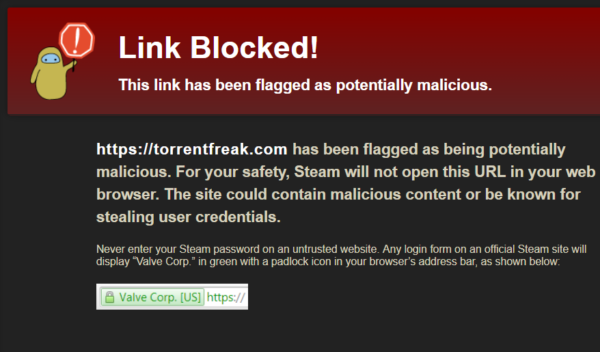
While these are just two examples, we could go on forever. As the large image below shows, Steam has banned our entire platform and put up a warning that’s not only completely false but also damaging to our reputation.

“https://ift.tt/JHJIUI has been flagged as being potentially malicious. For your safety, Steam will not open this URL in your web browser. The site could contain malicious content or be known for stealing user credentials,” the warning reads.

Stealing user credentials? Insulting and ridiculous

Of course, on its own platform Steam is fully entitled to block resources that it believes can harm its users. Some might even argue that it has a duty of care to do so, in order to keep its community safe. However, making blatantly false statements while blocking access to accurate news reporting shouldn’t ever be part of that.

Steam is no stranger to blocking links to sites in the file-sharing niche. Previously we’ve reported how it blocked links to KickassTorrents, The Pirate Bay, and MEGA.nz.

While the ban on MEGA was lifted shortly after our article was published back in April, the company appears to be out of favor with Steam once again. Tests show that Mega.nz links are completely banned by the gaming platform with a warning about malicious content and potential stealing of credentials. Meanwhile, known scam sites such as Demonoid.to are in the clear, according to Steam.

There is nothing malicious about our news resource and we’re really upset at the suggestion we might steal user credentials. We’d therefore be very grateful indeed if a Steam engineer could remove TorrentFreak.com from its blacklists, whenever he or she gets a couple of free minutes.

Source: TF, for the latest info on copyright, file-sharing, torrent sites and more. We also have VPN reviews, discounts, offers and coupons.


from TorrentFreak https://ift.tt/2OAQyoP
via IFTTT

Friday, October 19, 2018

Operator of YouTube Rippers Should Stand Trial in the US, Major Labels Say

Streamripping sites are seen as the largest piracy threat to the music industry, so record labels are doing their best to shut them down.

Last year YouTube-MP3, the world’s largest ripping site at the time, shut down after being sued, and several other folded in response to increased legal uncertainty.

Not all stream-ripping sites are folding without a fight though. FLVTO.biz and 2conv.com, owned by the Russian developer Tofig Kurbanov, remain online despite being sued by several record labels in August.

Two weeks ago, Kurbanov filed a motion to dismiss the case at the Federal Court in California. According to the defense, the court has no jurisdiction over the matter. Less than 6% of all visitors come from the US, and the site is managed entirely from Russia, it argued.

This week the RIAA labels, including Universal, Warner Bros, and Sony, responded to the motion to dismiss, clearly disagreeing with the defense. They argue that the operator of FLVTO.biz and 2conv.com downplays the connections to the US and Virginia.

In their memorandum, the record labels argue that both sites had millions of visitors from the United States over the past twelve months.

“[I]n the past year alone, Defendant’s websites had over 542,000 users from Virginia, who visited the sites more than 1.3 million times, and over 31 million users from the United States as a whole, who visited the sites more than 96 million times,” they write.

2conv.com

In addition, they point out that the sites have done business with U.S.-based web-hosting services, domain-name registrars, and advertising firms. Up until recently, some servers were even located in Virginia, the plaintiffs write.

These and other arguments are more than sufficient for the court to have jurisdiction over the case, the RIAA labels argue.

If a dismissal is not an option, the stream-ripper operator asked to transfer the case to a California court. Some of the parties are located there, while none are in Virginia, and it would be easier to access evidence.

However, the major record labels refute this argument as well.

“Wherever the case is held, there will be some burden associated with accessing evidence. But Defendant does not explain why it will be especially difficult to litigate this case in Virginia, or why transferring the case to the Central District of California will resolve those hypothetical problems,” they write.

It’s now up to the Virginia Federal Court to decide how to move forward. As noted by Digital Music News who covered the motion to dismiss, a hearing on the matter has been set for November 9th.

Thus far the case is only dealing with jurisdictional issues. If the case continues, the alleged copyright infringements or lack thereof, are expected to be argued in more detail.

Here are copies of Tobig Kurbanov’s motion to dismiss (pdf) and record labels’ response (pdf), both obtained by TorrentFreak.

Source: TF, for the latest info on copyright, file-sharing, torrent sites and more. We also have VPN reviews, discounts, offers and coupons.


from TorrentFreak https://ift.tt/2CVreUr
via IFTTT

Pirate Bay Founder’s ‘Njalla’ Criticized For Protecting Pirate Sites

After many years of targeting people who share larger volumes of content on peer-to-peer file-sharing apps and services, Japan is now taking aim at pirate sites.
In basic terms, rightsholders would like to see overseas pirate sites blocked by local ISPs, in much the same way as they are in dozens of countries elsewhere in the world. However, the process is proving a difficult one to move forward, as interference with communications is viewed by many as an invasion of users’ browsing privacy.

The Japanese Government is currently attempting a review on piracy measures for the Internet and has requested input from rightsholders and other interested parties. That’s resulted in a submission from CODA (Content Overseas Distribution Association), an anti-piracy coalition featuring major video, publishing, and software organizations.

“Infringement of rights occurs across national boundaries due to the development of the Internet, and the identification of infringers is extremely difficult. The response to this is extremely difficult and we believe that there are limits under the existing laws of Japan, and new initiatives are necessary,” CODA writes in a submission seen by TF.

Noting that criminal complaints and other measures against several targeted ‘pirate’ have proven ineffective, CODA says it is being hindered by online services that help to keep operators anonymous.

So-called “bulletproof” hosters that ignore copyright law are highlighted first. These providers have policies in place to protect their customers, often ignoring takedown notices filed under the DMCA while hiding identities of site operators. Bulletproof hosters were described as an emerging threat by the RIAA recently.

CODA also complains about domain privacy services which allow domain registrants to hide their identities from prying eyes. One such service, Njalla, which was launched by Pirate Bay co-founder Peter Sunde last year, is singled out for criticism.

“[S]ervices such as offshore hosting / bulletproof hosting that ignore the DMCA and domain registry services selling complete anonymity are rampant. It is now clear that [pirate site] ‘Mangamura’ was also using Njalla,” CODA adds.

Mangamura was a huge pirate manga site that apparently shut itself down last April. In the last few months of its life alone, the site was accessed well over half a billion times. This led to Toyko-based Kodansha, Japan’s largest publisher, to file a criminal complaint against the platform. CODA estimates that Mangamura caused losses amounting to US$2.9 billion.

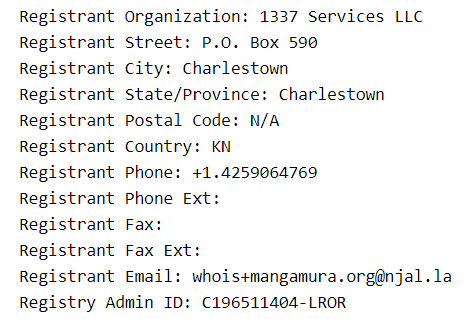
Given the specific mention in the submission, it seems likely that Mangamura’s use of Njalla caused problems for rightsholders and/or investigators. Njalla helps to keep the registration details of domain names private by registering domains in its own name (holding company 1337 Services LLC), not the customer’s, meaning that the owner of Mangamura should be harder to trace.

Mangamura.org Njalla WHOIS

An agreement allows the customer to use Njalla-registered domains however they like (as long as it doesn’t hurt someone’s “health or safety”) and they are able to take domains back or transfer them at any time. In the meantime, they are shielded from third-parties discovering who is really behind their domains.

TorrentFreak asked Njalla whether they’ve ever had any complaints about Mangamura’s registration but at the time of publication, the service was yet to respond. However, one only has to read a sample of the company’s interactions with content company lawyers to see how it sometimes responds.

In the meantime, CODA continues to push its case to introduce blocking mechanisms in Japan. This wouldn’t solve the anonymity problem posed by bulletproof hosters and services like Njalla, but having ‘pirate’ sites rendered inaccessible in the country would certainly help.

That being said, things are not going smoothly.

According to a report published by Mainichi, a panel of government experts has been unable to compile an interim report on measures against pirate sites due to disagreements over the suitability of site blocking.

While rightsholders believe the practice should be implemented as soon as possible, there are serious concerns that blocking violates the country’s constitution.

“There are strong misgivings among many of the panel members who specialize in law that blocking is unconstitutional, and it’s unacceptable,” said Ryoji Mori, a lawyer on the panel.

On Wednesday, nine panel members opposed to blocking issued a statement, insisting that legislation “should be deferred and cooperation sought with the private sector to advance measures other than blocking.”

Those measures are said to include restriction of advertising on ‘pirate’ sites to hit revenues, plus further cooperation between content creators and the telecoms industry. Several ISPs in Japan currently block several ‘pirate’ sites voluntarily.

Source: TF, for the latest info on copyright, file-sharing, torrent sites and more. We also have VPN reviews, discounts, offers and coupons.


from TorrentFreak https://ift.tt/2PbPLKD
via IFTTT